Showing posts with label preservative free. Show all posts

Tuesday, 8 September 2015

What to drink with Baked Beans! And confessions of a crush on Andrew McConnell.

Being a left-leaning, middle class, inner city dweller it should come as no surprise that I subscribe to The Saturday Paper, the paper put out by the publishers of The Monthly and The Quarterly Essay.  It is lovely to read a paper that affirms all of my own beliefs, and makes it easy to forget that there are other people out there who don't share them.  But, if I really had to admit why I love The Saturday Paper so much (aside from the quiz), I would confess that I actually have a super foodie crush on Andrew McConnell, and he is their weekly food and recipe columnist.  

For those of you not familiar with Andrew, (SHAME ON YOU!) he is part owner of Cumulus Inc, Cutler and Co, and Super Normal.  His food really ticks all the right boxes for me.  He's moved away from all that 'molecular gastronomy', foams, deconstructed this and that, and makes delicious dishes that are both delicate and hearty at the same time.  The parfait at Cumulus Inc. is like fluffy pate goodness, and is enjoyed with a glass of Prosecco is pretty much the nearest thing to heaven on Flinders Lane.   


This week Andrew's column was a recipe for Baked Beans with ham hock.  Now, I've made baked beans from scratch several times, but these ones seemed just too easy!  Limited ingredients, using time and care to make them taste amazeballs.  Off I trotted to get the ingredients and after a day of boiling a hock, lovingly soaking beans and preparing an uber tasty tomato sauce the beans were served.  SERIOUSLY GOOD.  I doubled the quantity, which means we've been eating beans all week in various guises.  These babies were plump, soft, yet still in shape, and nothing at all like the mush that comes from a can.  

I served them a number of ways:
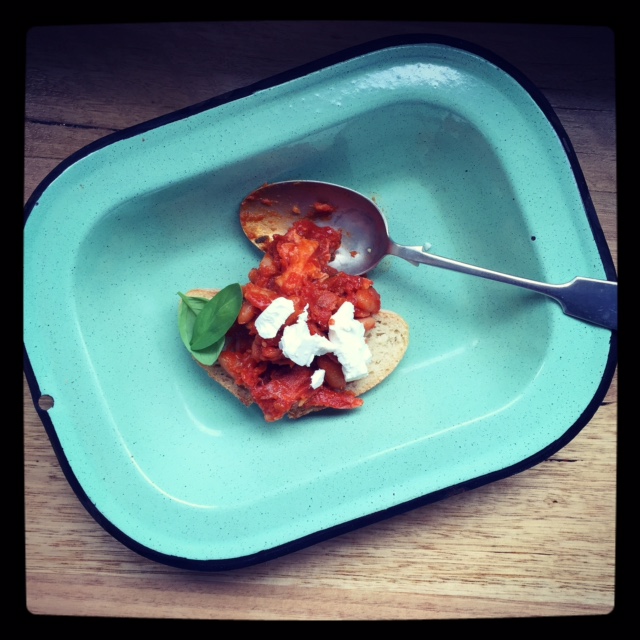
1.  As a dinner, straight up with chunks of toasted ciabatta.
2.  As lunch, with pan fried mushrooms and spinach.
3.  As dinner, with a couple of poached eggs and some crumbled fetta cheese. 

I've still got some left, and am debating whether or not to experiment with freezing a container full, I'm unsure if the beans will survive a defrost...  


What did I drink with these beans I hear you ask?  Well, on the first night, I had slaved over these beans, and felt they were worthy of a kicking big red, so I cracked open a Paxton MV Shiraz. It was recently awarded 95 points by James Halliday.  James say on his website: 'The grapes come from four estate biodynamic vineyards, plus two contract biodynamic vineyards; separately fermented and matured in new and used American oak. Deep, dark crimson... with waves of sultry black fruits and bitter chocolate, the oak not blunting the delicious savoury nature of the wine...'  


I love this wine.  David Paxton really knows his stuff, which is why we stock quite a range of his wines.  You can buy it now on our website!


More thought into food and wine matching lead me to Tempranillo for subsequent meals.  This savoury drop goes well with spicy, tomatoey food - especially Spanish food.  We've written a 101 lesson about Tempranillo on our website.  Basically, it is a champion with food.  Four Tempranillo (or tempranillo blends) are currently gracing our shelves.  You can peruse them here.   I opened a Vicente Gandia Tempranillo from Spain.  It's as cheap as chips, and really tasty.  It's often my fall back wine for quaffing, or with a thrown together meal.  It's full of the intense aromas of cassis combined with black currant.  To taste there are liquorice and black currant notes.  It is a well balanced wine, and stands up to rustic food flavours.  Perfect with my beans!  

I'll include Andrew's winning recipe below.  I only made minor changes (I doubled the herbs and added 4 anchovies to the tomato sauce for a bit of extra zing).

Andrew's Baked Beans.


Ingredients:

1 smoked ham hock
1 cup dried white beans (soaked overnight).  Andrew recommends cannellini beans - the smallest you can find.
1/2 brown onion, finely diced
1 clove garlic, sliced (I used more)
2 tbsp grapeseed oil (I used olive oil)
1/2 tsp smoked paprika
1/2 tsp brown sugar
2 tbsp brandy (I used Armagnac)
100 mls white wine
1 tin diced tomatoes
1 tbsp tomato paste
2 sprigs fresh thyme (I used more because I have an awesome thyme bush)
1 Bay leaf (I used more for the same reason as above) 
salt
fresh ground black pepper
1 tbsp red wine vinegar


Method:

Place ham hock in a large saucepan and cover with cold water.  Bring the water to the boil and then lower the heat and simmer the hock until it is tender (about an hour and a half).

Preheat oven to 140 degrees C.

Cover your drained beans in cold water and bring to the boil.  Simmer for 5 minutes and drain.  

In an ovenproof saucepan gentle saute onion and garlic in the oil.  Once soft add the praprika and sugar and fry for one minute.  Add brandy and reduce by half.  Add wine and reduce by half again.  Add drained beans, tinned tomatoes, tomato paste, thyme sprigs, bay lead and enough ham stock to just cover the beans.  I added the anchovies at this point.

Bring beans to a simmer, cover with a tight fitting lid and put in the over.  While they are cooking (for about an hour), pick the ham from the bone and shred.  Once the beans are meltingly tender, but not disintegrating, pull them out, stir through ham and cook for a further 5 minutes.  

I needed to add extra ham stock during the baking process, so keep an eye on the pot!

Season with salt, pepper and red wine vinegar.  Serve as you like (see suggestions above).

Happy drinking!
 

Monday, 24 August 2015

What's with the big 'O'...? What is organic wine?

So, what exactly is 'Organic Wine'?  

It's obviously been the burning question, plaguing you night and day, causing you to lose sleep, etc...  Well, look no further than this handy little post to answer your question, restore your sleep and hopefully give you an edge come the next trivia night you're involved in.

It's really a two parter.   

Firstly, and in my opinion, one of the most important questions in life to date...

WHAT IS WINE?

Well, a super brief 101 lesson...WINE is the fermented juice of grapes (or other fruits and grains).  The juice can be treated in a variety of ways, yeasts added (or natural yeasts relied on to kick off the fermenting), skins left on, or removed, the juice aged in barrels made of oak, or in glass bottles, or steel vats, etc.  Essentially, grape based wine is a delicious alcoholic beverage which can come in red, white, rose, or sparkling varieties.  There are many different grape varietals all with their own distinct flavour profiles.  Wine has been around for thousands of years...archeologists have unearthed jars of wine as old as 9000 years, but I think it's pretty safe to say that people were enjoying the heady effects of wine (or some kind of equivalent) since the dawn of man.


Secondly, and also extremely important...

WHAT DOES ORGANIC MEAN (in reference to wine, of course)?


In terms of farming, ORGANIC is a form of agriculture that relies only on the use of natural fertilizers, herbicides and pesticides.  Often organic farming is very mindful of the environment, trying to farm in ways which minimise impact on the land, this can include crop rotation, companion planting, etc.  No artificial chemicals, no genetically modified organisms, and in the case of animals, no antibiotics or artificial growth stimulating hormones, are used in the production of organically farmed plants or animals.

Rainbows over the Rosnay Organic Vineyards.

Organic farming practices are as old as agriculture itself, and thankfully have seen a resurgence of popularity in more recent times.  Many of the chemicals that have been used in the past, and even today, have a dubious record when it comes to potential damage to the environment, animals and people.  I figure if there is a way to farm without them, why not?!

WHAT IS ORGANIC WINE?


Well, putting the two pieces of information above together, pretty clearly spells out that ORGANIC WINE is wine that is created using only grapes (or other additives) which are farmed/produced organically.  This means that if milk products are added, or yeasts added they must be organic as well.


How about those PRESERVATIVES?


It must be remembered that organic wine is not always preservative free wine.  Sulfur dioxide, and any other preservatives in their purest form are organic too!  So, if you are looking to avoid added preservatives in your vino you will need to look beyond the organic label alone. {I'll do a post on preservative free wines soon, but for now don't want to overload the information receivers.  If you're keen for more information immediately, check out our website.}


Another really interesting thing about organic vineyards and wine makers (and indeed any organic producer), is that wine can be produced according to organic philosophies and practices without being Certified Organic.  Organic certification is quite expensive, and incredibly prescriptive.  Farms with organic certification must undergo extensive and testing, and jump through loads of hoops to make sure they keep their organic status.  There can be no hint that there are non organic chemicals anywhere near their farms, and they have to have been farming organically for several years before even being considered for certification.  Many farms, and wine makers, are happy to forgo the certification process, and just go about their organic farming business, they are permitted (in Australia) to label their wine as being produced according to organic farming philosophies, but they cannot say they have certification, or use the Australian Certified Organic logo.  In many ways this can be a tricky business for wineries, as the logo and certification is often the first thing that consumers look for and can trust.  You can have a read about ACO on their website for more details about the process of certification.  


As an example, Freehand Wines, a lovely little wine producer in Western Australia, produces natural wine according to organic and biodynamic philosophies, but does not have certification.  I've met the people behind the Freehand Label - Matt Eastwell, and Danni, his partner in wine making and life, they are passionate about farming without the use of man-made chemicals and additives.  Their wine is absolutely organic and biodynamic.  No certification necessary!  


The message is: 

1.  Not having organic certification, does not necessarily mean that wine is not organic, check out Freehand as an example.

2.  Organic wine is not necessarily Preservative Free wine, nor is it always Vegan friendly

Happy drinking!