Showing posts with label natural wine. Show all posts

Tuesday, 8 September 2015

What to drink with Baked Beans! And confessions of a crush on Andrew McConnell.

Being a left-leaning, middle class, inner city dweller it should come as no surprise that I subscribe to The Saturday Paper, the paper put out by the publishers of The Monthly and The Quarterly Essay.  It is lovely to read a paper that affirms all of my own beliefs, and makes it easy to forget that there are other people out there who don't share them.  But, if I really had to admit why I love The Saturday Paper so much (aside from the quiz), I would confess that I actually have a super foodie crush on Andrew McConnell, and he is their weekly food and recipe columnist.  

For those of you not familiar with Andrew, (SHAME ON YOU!) he is part owner of Cumulus Inc, Cutler and Co, and Super Normal.  His food really ticks all the right boxes for me.  He's moved away from all that 'molecular gastronomy', foams, deconstructed this and that, and makes delicious dishes that are both delicate and hearty at the same time.  The parfait at Cumulus Inc. is like fluffy pate goodness, and is enjoyed with a glass of Prosecco is pretty much the nearest thing to heaven on Flinders Lane.   


This week Andrew's column was a recipe for Baked Beans with ham hock.  Now, I've made baked beans from scratch several times, but these ones seemed just too easy!  Limited ingredients, using time and care to make them taste amazeballs.  Off I trotted to get the ingredients and after a day of boiling a hock, lovingly soaking beans and preparing an uber tasty tomato sauce the beans were served.  SERIOUSLY GOOD.  I doubled the quantity, which means we've been eating beans all week in various guises.  These babies were plump, soft, yet still in shape, and nothing at all like the mush that comes from a can.  

I served them a number of ways:
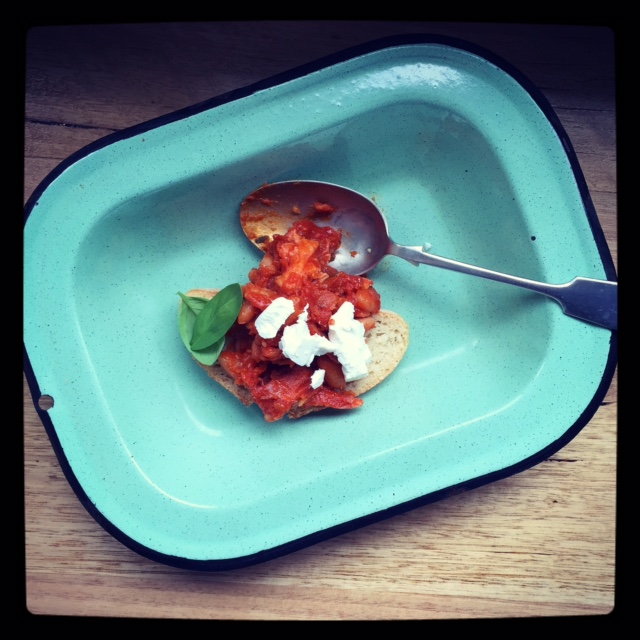
1.  As a dinner, straight up with chunks of toasted ciabatta.
2.  As lunch, with pan fried mushrooms and spinach.
3.  As dinner, with a couple of poached eggs and some crumbled fetta cheese. 

I've still got some left, and am debating whether or not to experiment with freezing a container full, I'm unsure if the beans will survive a defrost...  


What did I drink with these beans I hear you ask?  Well, on the first night, I had slaved over these beans, and felt they were worthy of a kicking big red, so I cracked open a Paxton MV Shiraz. It was recently awarded 95 points by James Halliday.  James say on his website: 'The grapes come from four estate biodynamic vineyards, plus two contract biodynamic vineyards; separately fermented and matured in new and used American oak. Deep, dark crimson... with waves of sultry black fruits and bitter chocolate, the oak not blunting the delicious savoury nature of the wine...'  


I love this wine.  David Paxton really knows his stuff, which is why we stock quite a range of his wines.  You can buy it now on our website!


More thought into food and wine matching lead me to Tempranillo for subsequent meals.  This savoury drop goes well with spicy, tomatoey food - especially Spanish food.  We've written a 101 lesson about Tempranillo on our website.  Basically, it is a champion with food.  Four Tempranillo (or tempranillo blends) are currently gracing our shelves.  You can peruse them here.   I opened a Vicente Gandia Tempranillo from Spain.  It's as cheap as chips, and really tasty.  It's often my fall back wine for quaffing, or with a thrown together meal.  It's full of the intense aromas of cassis combined with black currant.  To taste there are liquorice and black currant notes.  It is a well balanced wine, and stands up to rustic food flavours.  Perfect with my beans!  

I'll include Andrew's winning recipe below.  I only made minor changes (I doubled the herbs and added 4 anchovies to the tomato sauce for a bit of extra zing).

Andrew's Baked Beans.


Ingredients:

1 smoked ham hock
1 cup dried white beans (soaked overnight).  Andrew recommends cannellini beans - the smallest you can find.
1/2 brown onion, finely diced
1 clove garlic, sliced (I used more)
2 tbsp grapeseed oil (I used olive oil)
1/2 tsp smoked paprika
1/2 tsp brown sugar
2 tbsp brandy (I used Armagnac)
100 mls white wine
1 tin diced tomatoes
1 tbsp tomato paste
2 sprigs fresh thyme (I used more because I have an awesome thyme bush)
1 Bay leaf (I used more for the same reason as above) 
salt
fresh ground black pepper
1 tbsp red wine vinegar


Method:

Place ham hock in a large saucepan and cover with cold water.  Bring the water to the boil and then lower the heat and simmer the hock until it is tender (about an hour and a half).

Preheat oven to 140 degrees C.

Cover your drained beans in cold water and bring to the boil.  Simmer for 5 minutes and drain.  

In an ovenproof saucepan gentle saute onion and garlic in the oil.  Once soft add the praprika and sugar and fry for one minute.  Add brandy and reduce by half.  Add wine and reduce by half again.  Add drained beans, tinned tomatoes, tomato paste, thyme sprigs, bay lead and enough ham stock to just cover the beans.  I added the anchovies at this point.

Bring beans to a simmer, cover with a tight fitting lid and put in the over.  While they are cooking (for about an hour), pick the ham from the bone and shred.  Once the beans are meltingly tender, but not disintegrating, pull them out, stir through ham and cook for a further 5 minutes.  

I needed to add extra ham stock during the baking process, so keep an eye on the pot!

Season with salt, pepper and red wine vinegar.  Serve as you like (see suggestions above).

Happy drinking!
 

Friday, 4 September 2015

Food and Wine Pairing: Rosé

It seems that if you put 'food and wine pairing' into a search engine these days you will be completely inundated with blog posts and web pages galore telling you which drop goes best with what dish.  It's a complicated business. In the interests of making things a bit simpler, and a bit more hands on, I've decided to do some regular posts on the topic, and I might even add in the occasional recipe to try along with some suggested wine matches.

I absolutely love cooking, it's totally my 'down time' thing.  In my younger years (not all that long ago, I might add), I would spend days preparing special dishes for dinner parties.  I held an Indian dinner party for 16 people once, there were 5 curries, all prepared from scratch.  I don't get the chance to do as much of it as I used to (thanks kids!!), but I still get to salivate over recipe books, and occasionally there is a special dinner party, or a romantic evening planned, where I can try out something a bit more complicated than pasta and meat sauce (again, thanks kids...). Anyway, matching the food I cook to the perfect beverage is also a passion.  There is nothing worse than sitting down to a cracking good meal, and taking a sip of completely the wrong wine.  There can be a massive clash of flavours in your mouth, spoiling what could have been a marriage made in heaven.

We've got a few Rosés up on our website, and just this week we introduced a great new Preservative Free Rosé from Temple Bruer in stock at the moment.  It's seriously awesome, and has inspired me to write about this 'Pink Drink' that is often scorned by those who 'think' they know a thing or two about wine.  Now, rose has been given a bad wrap over the years.  It has serious associations with 1970s dinner parties, women in platform shoes, gold one piece jump suits, glossy lipstick and overly sweet PINK wine.  I'm here to tell you that it's time to put aside old prejudices and look at that pink vino with new eyes.  It's versatile to the max, and I'm sure that there will be a style that is bound to float your boat. 


The Temple Bruer 2014 Preservative Free Rosé, is a real beauty.  It is awash with flavours of cherry, watermelon and citrus. The crisp palate shows tropical fruit and citrus, fresh pineapple and lime characters. There is a little hint of chalky tannins on the finish and a cleansing gentle acidity. It's a wine of medium weight (and only 12% alcohol!) and is well suited to many Asian foods.  I served it up with a curry last night and all were suitably impressed.  We've got this for sale from $18.50 on our website.  Seriously, do yourself a favour and try it.  One word:  YUM.


So the upshot is, Rosé is not necessarily sweet.  In fact, you'd have to have been living under a rock not to have noticed the sheer number of different kinds of Rosés available at your local bottle-o.  Just to give you a mini 101 lesson on the kinds of Rosé available, as well as the kinds of food you might serve with them...read on!

Light dry Rosé - 
This style is generally made with Pinot Noir grapes.  The closest comparison would be to a crisp dry white like a Pinot Gris.  It pairs amazingly well with light meals, salads, a light pasta or rice dish, goats cheese, seafood, shellfish.  Basically it is great for summer time drinking.

Light off-dry Rosé - 
This style is similar that above, but with a touch of sweetness.  It is more in line with a traditional rosé from Portugal (Mateus).  This pairs well with the same foods are above, but also lightly spiced dishes, like an Indian curry or Asian foods.  If you're keen to try this style, we've got a lovely Knight's Templar Rose.

Medium dry Rosé - 
Zinfandel or sparkling zin.  This kind of rosé is often called 'Blush' .  And you guessed it, it pairs well with the above foods including the spicy foods.  It also kicks as a dessert wine, provided the dessert isn't overly sweetened.

Medium bodied dry Rosé -
 This style is in line with rose from the Spanish Rioja region.  It is very accommodating in terms of food matching.  It's not overly sweet, and It can stand up to some punchy flavours, like olives, garlic, anchovies, etc.  It goes well with a good paella, grilled meats, a charcuterie plate, tapas, pre-dinner nibbles of pate or rillettes.  It's a winner.

Elegant, Fruity Rosé - 
Often Melot based, this is a rosé with many of the same qualities as a good Pinot Noir.  It should be drunk with big ticket dinner items like rare lamb, duck, salmon, tuna, or if you're feeling flush, LOBSTER!

Full bodied fruity Rosé - 
You'll find lots of these in Australia.  And in line with our obsession with Shiraz and flavours that are bold, big and obvious, this Rosé is all that.  It's heavy handed with the fruit flavours.  It's often served chilled and goes well with curries, Asian food, a barbeque or the like.  

Sparkling Rosé - 
These are lots of these on the Australian market, and for good reason.  They're fun and tasty!  They are a great social drink, and can range from dry to medium dry.  They are great with nibbles (cheese, nuts, smoked salmon, etc), or can be served with sweet treats like cakes and sweet tarts.  We've got a lovely Rosnay Sparkling Vintage Rose for a good price.

Rosé Champagne - 
For really impressing someone!  Again, these can vary between lighter and more full bodied flavours and levels of sweetness.  This style usually suits canapes, like Blinis and such.  A more serious vintage number would go well with game birds.

I hope this little post has helped clarify matters for you.  Normally I'll include a recipe to match the wine varietal that I'm food pairing with, but there is such a huge variation in styles of Rosé that I could be blogging for hours.  I think the info I've given you should be sufficient to lead you in the right direction when it comes to preparing a suitable meal to go with any Rosé.  And should you want to try a good Organic or Preservative Free Rosé, please check out our website.  Good wine, good value!


Happy drinking!

Monday, 24 August 2015

What's with the big 'O'...? What is organic wine?

So, what exactly is 'Organic Wine'?  

It's obviously been the burning question, plaguing you night and day, causing you to lose sleep, etc...  Well, look no further than this handy little post to answer your question, restore your sleep and hopefully give you an edge come the next trivia night you're involved in.

It's really a two parter.   

Firstly, and in my opinion, one of the most important questions in life to date...

WHAT IS WINE?

Well, a super brief 101 lesson...WINE is the fermented juice of grapes (or other fruits and grains).  The juice can be treated in a variety of ways, yeasts added (or natural yeasts relied on to kick off the fermenting), skins left on, or removed, the juice aged in barrels made of oak, or in glass bottles, or steel vats, etc.  Essentially, grape based wine is a delicious alcoholic beverage which can come in red, white, rose, or sparkling varieties.  There are many different grape varietals all with their own distinct flavour profiles.  Wine has been around for thousands of years...archeologists have unearthed jars of wine as old as 9000 years, but I think it's pretty safe to say that people were enjoying the heady effects of wine (or some kind of equivalent) since the dawn of man.


Secondly, and also extremely important...

WHAT DOES ORGANIC MEAN (in reference to wine, of course)?


In terms of farming, ORGANIC is a form of agriculture that relies only on the use of natural fertilizers, herbicides and pesticides.  Often organic farming is very mindful of the environment, trying to farm in ways which minimise impact on the land, this can include crop rotation, companion planting, etc.  No artificial chemicals, no genetically modified organisms, and in the case of animals, no antibiotics or artificial growth stimulating hormones, are used in the production of organically farmed plants or animals.

Rainbows over the Rosnay Organic Vineyards.

Organic farming practices are as old as agriculture itself, and thankfully have seen a resurgence of popularity in more recent times.  Many of the chemicals that have been used in the past, and even today, have a dubious record when it comes to potential damage to the environment, animals and people.  I figure if there is a way to farm without them, why not?!

WHAT IS ORGANIC WINE?


Well, putting the two pieces of information above together, pretty clearly spells out that ORGANIC WINE is wine that is created using only grapes (or other additives) which are farmed/produced organically.  This means that if milk products are added, or yeasts added they must be organic as well.


How about those PRESERVATIVES?


It must be remembered that organic wine is not always preservative free wine.  Sulfur dioxide, and any other preservatives in their purest form are organic too!  So, if you are looking to avoid added preservatives in your vino you will need to look beyond the organic label alone. {I'll do a post on preservative free wines soon, but for now don't want to overload the information receivers.  If you're keen for more information immediately, check out our website.}


Another really interesting thing about organic vineyards and wine makers (and indeed any organic producer), is that wine can be produced according to organic philosophies and practices without being Certified Organic.  Organic certification is quite expensive, and incredibly prescriptive.  Farms with organic certification must undergo extensive and testing, and jump through loads of hoops to make sure they keep their organic status.  There can be no hint that there are non organic chemicals anywhere near their farms, and they have to have been farming organically for several years before even being considered for certification.  Many farms, and wine makers, are happy to forgo the certification process, and just go about their organic farming business, they are permitted (in Australia) to label their wine as being produced according to organic farming philosophies, but they cannot say they have certification, or use the Australian Certified Organic logo.  In many ways this can be a tricky business for wineries, as the logo and certification is often the first thing that consumers look for and can trust.  You can have a read about ACO on their website for more details about the process of certification.  


As an example, Freehand Wines, a lovely little wine producer in Western Australia, produces natural wine according to organic and biodynamic philosophies, but does not have certification.  I've met the people behind the Freehand Label - Matt Eastwell, and Danni, his partner in wine making and life, they are passionate about farming without the use of man-made chemicals and additives.  Their wine is absolutely organic and biodynamic.  No certification necessary!  


The message is: 

1.  Not having organic certification, does not necessarily mean that wine is not organic, check out Freehand as an example.

2.  Organic wine is not necessarily Preservative Free wine, nor is it always Vegan friendly. 

Happy drinking!

Sunday, 9 August 2015

Crackers and White Frontignac

This weekend was a quite one at my place.  We've all been knocked out with various illnesses, and this was the time to catch up on some relax time around the house.  You know the drill, lots of crawling back into bed with the newspaper, endless cups of tea, DVD marathons.  Fun!

However, with three small children in the house there also had to be some 'action'.  So we chose baking.

I've made my own crackers before, and honestly I can't rave enough about them.  Crackers that you buy from the supermarket often have long list of 'ingredients', many of these ingredients are just numbers....hmmm.  And more often than not the vegetable oil they use is unlabelled palm oil.  We are massive palm oil avoiders knowing how damaging the industry is for the environment, and how animals (namely, and most famously, orangutans and sun bears) are being killed and displaced just so we can have tasty crackers or two minute noodles.  I much prefer to know exactly what I'm eating, and what my kids are eating...hence organic wine, and home made goodies!   

**If you're passionate about palm oil, you can have a look at the P.O.I. (Palm Oil Investigations), which has a handy app to tell you if something is palm oil free, or from certified palm plantations. 


These crackers are really easy (if a little time consuming), and the result is always a winner. I've done a bit of research, and have discovered a recipe that is pretty much foolproof.  I nabbed it from fellow blogger at 'The Kitchn'  who seems to have quite a few nice looking recipes and a cook book to boot.  I'll pop my slightly modified recipe below so that you can just get in and start making.


Anyway, once the crackers were baked, there was a required 'tasting' session.  What better to have with a plate of crackers and Danish fetta cheese?  A zesty white wine of course! I chose to crack open one of my faves, a White Frontignac by Temple Bruer.  It is one of their limited release natural wines, made by Verity Stanistreet, and honestly it is good, good, good!  There were only 44 dozen bottles of this wine made, so it's worth trying to get your hands on it if you can (which you can!).  


White Frontignac is an interesting drop and not a varietal that you come across often.  To taste, there are notes of rose, pear and lychee which gently grip your mouth.  Then the flavour palette shifts to  spearmint and tangy lemon sorbet.  It's quite something... a really interesting wine, in both taste and mouth feel.  The wine was fermented partly on solids to provide extra texture and mouth feel.  


If your mouth is watering now, why not order a bottle? 


Happy drinking!


The Delicious and Easy Cracker Recipe


Ingredients
3 cups plain flour
2 teaspoons sugar
2 teaspoons salt
4 tablespoons extra-virgin olive oil
1 cup water
 

Optional topping: 1 tablespoon sesame seeds, 1 tablespoon fennel seeds, 1 tablespoon poppy seeds, 1 teaspoon sea salt
 
Equipment
Mixing bowl
Measuring cups and spoons
Sturdy spoon or spatula
Rolling pin
Pastry brush
Pizza cutter or sharp knife
Baking sheet
Dinner fork


Instructions

  1. Heat the oven to 210°C: 
  2. Line some baking trays with non stick baking paper.
  3. Mix together the dry ingredients.
  4. Add the oil and water:  Stir until a soft, sticky dough is formed. If a lot of loose flour remains in the bottom of the bowl and the surface of the dough, add more water a tablespoon at a time until all the flour is incorporated.
  5. Divide and shape the dough into a square: Divide the dough into two halves and set one half aside. Sprinkle your work surface lightly with flour and set the other half on top. Pat it into a thick square with your hands.
  6. Roll out the dough: Working from the center of the dough out, roll the dough into a rectangle roughly 3-4mm thick or thinner if you prefer crispier crackers. If the dough starts to shrink back as you roll it, let it rest, uncovered, for 5 minutes and then continue rolling.
  7. Sprinkle dough with topping (optional): Brush the surface of the dough very lightly with water. Combine the seeds in a small bowl and sprinkle half of them (roughly 1 1/2 tablespoons) evenly over the surface of the dough.Press the seeds or toppings into the dough (you could even lightly roll the dough again).
  8. Cut the dough into cracker-sized rectangles: Using a pizza cutter or a sharp knife, cut the dough into individual crackers roughly 3 cm by 3 cm. Alternatively, cut the crackers into squares, diamonds, or use cookie cutters.  We went pretty free form, as the kids were helping.
  9. Transfer crackers to baking tray and prick with fork:  It's fine to crowd the crackers very close to each other. Prick each cracker with the tines of a fork to prevent them from puffing during baking.
  10. Bake for 12-15 minutes: Bake the crackers in the oven for 12-15 minutes, until the edges are browned. Thinner crackers will bake more quickly than thicker ones; you can remove the crackers as they brown to your liking and continue baking the rest. While the first batch of crackers is baking, roll out and cut the remaining dough.
  11. Cool and store the crackers: Transfer the baked crackers to a wire rack to cool completely. The crackers will crisp further as they cool. Store the crackers in an airtight container on the counter for 3-5 days (they won't last that long!). If you're crackers are a little old and less-than-crispy, lay them on a baking sheet and put them in a 180°F oven for a few minutes to re-crisp.
TOPPINGS:  I added a good couple of teaspoons of garlic power to the dry ingredients, which gives the crackers a bit of a kick. For one batch I added finely chopped herbs from the garden to the dough and then topped with finely grated parmesan cheese...DELICIOUS!  The second back I topped with poppy seeds, sunflower seeds and sea salt.  Scrumbo and very crispy.  Other toppings could include chilli flakes, fennel seeds,  pesto, or really anything you feel brave enough to try.  If using a wet ingredient like pesto, you may need to adjust the amount of water or oil you add.