Monday, 30 November 2015

Organic Christmas Hampers


Christmas Hamper time!


I’ll tell you why I love receiving a hamper…  it’s full of stuff that I’ll actually USE and won’t be left trying to find a home for all year.  Don’t get me wrong, I love presents, BIG TIME.  However, as I’ve grown older, made my own home, have my own family, and have developed my own (very particular) aesthetic tastes I’ve become more fussy.  Sometimes getting a gift from an acquaintance of say: a teapot, a vase, a salad bowl, some candle holders…you get the drift, just doesn’t really thrill me to the back teeth.  I’ve got a house full of things and I don’t need another ‘item’.  Which brings me back to the brilliance of a hamper!  I can EAT and DRINK all of the things in it!  And even if they’re not all my favourite things I can bring them out to share at one of the multitude of holiday events that pop up at this time of year.  


We’ve got two hampers for sale this holiday season, one contains a range of organic tasty treats, all parcelled up in an attractive recycled box, the other contains those yummy treats, and CHAMPAGNE!  I’m betting money that you’ve got someone in your life who would be happy with either (or both!) of these scrummy hampers.  You know who I mean (Aunty Beryl who has everything you could ever need, a dear friend who lives miles away, your colleagues or employees), I’m sure you’re already compiling a list and tallying up the numbers.


If you’re not so keen to buy a whole hamper, we do have our hamper items for sale individually.  You might like to pair them up with a favourite wine, pop them in a gift bag and hand them out to children’s teachers, or ‘drop in’ friends.  Honestly, you can’t go wrong with a good organic wine and a delicious organic treat for a Christmas gift.


The low down:


GOURMET ORGANIC HAMPER:  This is a lovely selection of Australian Organic goodness; including your choice of a range of Alter Ego Fair Trade, organic chocolates and truffles, Rosnay fig preserve, Carwari Organic Salted Roasted Cashews, Bodhi Farm Organic Tassie Blend Dukkah, Pure Origins Organic Leatherwood Honey.  Did I mention, delicious?


Just add one or more of your favourite wines and you will have a fantastic gourmet organic gift.


CHAMPAGNE GOURMETORGANIC HAMPER:  This hamper contains all of the above tasty goodness, and a bottle of Authentic Organic and Biodynamic Champagne - Fleury Blanc de Noirs.  This is a delicious wine, and even without the additional gourmet adornments would be a lovely gift.   We are only stocking limited quantities of this Gold Medal winning Champagne, and with the toasty aromas,  hints of apple, almonds and nectarines and the well balanced acidity with minerally notes, we won’t be able to keep it on the shelves for long.  You are, of course, welcome to substitute the wine for a sparkling to suit your taste or budget.


Just click here to peruse our hamper items and place your order!  if you want these items to arrive in ample time for Christmas, with no stress or fuss, please place your order as soon as possible.

Monday, 23 November 2015

Gemtree Organic and Biodynamic Wines.


Delicious wines with a conscience.


In 1980 Paul and Jill Buttery established the Gemtree vineyards in McLaren Vale on must be left in better condition than they found it in.  Not content to just pay lip service to a philosophy, the Buttery family decided to act, preserving a 10 hectare section of land within the Gemtree vineyard in 1998.  This stretch of land, originally a degraded creek line, littered with rubbish and weeds, was lovingly cleaned up and replanted with over 50,000 plants contributing to the survival of local native species and ensuring an ecological balance is maintained on the property. The site is now a bio-diverse wetland and a haven for native birds, plants and animals. 
Thirty five years after realising their dream of caring for a vineyard, Paul and Jill have handed over the reins.  Now their son - Andrew runs the business, their daughter Melissa Brown is the Biodynamic Viticulturist and her husband, Mike Brown is the Chief Winemaker.  All share a passion for producing quality organic wines and their philosophy is simple ~ minimal intervention in the wine making process and a more environmentally conscious farming systems.  These beliefs as well as hard work, education and care, mean that the Gemtree Winery produces wines which are powerful, concentrated, and express the true characteristics of each grape variety and the region.  


Over the years the Gemtree vineyards have expanded from the original 38 acres containing Cabernet Sauvignon and Shiraz vines, sustained only by limited mains water.  With a bore sunk, and the purchase of adjoining parcels of land over the years, there are now 328 acres of Gemtree Vineyards, with 272 under vine.  There are now a huge spread of grape varietals being grown, grafted and tinkered with by the Buttery/Brown family:  Chardonnay, Verdelho, Savagnin, Merlot, Shiraz, Cabernet Sauvignon, Tempranillo, Petit Verdot. Riesling, Mataro, Pinot Noir, Sangiovese and even some Zinfandel.
 

Mike and Melissa are the hands-on people when it comes to grapes and wine.  Mike acknowledges that all great wines are made out in the vineyard.  Since the introduction of the biodynamic regime into their vineyards there has been a significant increase in fruit quality and intensity.  He sees it as his job to merely “massage and showcase” what his partner is doing out on the land.  Essentially, you will taste not only the true characteristics of the wine varietals of the region, but the results of this love of family, the environment, and their passionate philosophies about wine making, in every bottle of Gemtree Wine.
We’ve got a range of Gemtree wines available for sale on the website here, from an everyday quaffer like the Gemstone Chardonnay   or something a bit special like their Obsidian Shiraz (ah-mazing!)


When seeking out information about this winery, I came across this story on their website.  It’s a lovely little fable which sums up their philosophies in a neat package.  We hope you enjoy the tale, as well as the wine!
The Gemtree Story. (from the Gemtree website)

There was once a tree. Not the tallest tree, nor the oldest tree, but a tree that had put its roots in just the right part of the paddock. Here the soil was deep and layered - sometimes hard and rocky, elsewhere soft and sandy - and the wind had just enough room to move, and even the rain - when it was kind enough to visit - would fall evenly and gently.

Because of its favoured position, the grasses grew tall against its trunk, and the wild flowers were easily encouraged to grow closely around it, and the insects and birds that looked to trees for shelter and for vantage, eagerly moved in.

One day a farmer approached the tree and wondered: “You do not grow the strongest, nor the fastest, so why is it that you grow the best fruit?”

The tree let the answer whisper through the wind in its branches: “If I am shown a patient mind and a gentle hand, if I am left to follow the rhythms of my seasons – to rest in Winter; to revive in Spring; to make busy in Summer; and to provide in Fall – then I can offer fruit that tastes not just of the ground upwards, but also of the sky downwards, and of everything around me.”

The farmer thought to himself: “This is truly a Gemtree – it takes only what it can give back to the land, it contributes to its surroundings, and it provides for those that live around it.”


Tuesday, 3 November 2015

Organic Angove Cuvee Brut Sparkling


Angove Organic Cuvee Brut.


The silly season is here!  In the next few months there are going to be a multitude of occasions where a sparkling wine of good quality, and not outrageous cost, is required.  The Angove Cuvee Brut meets all the criteria of a delicious sparkling wine that isn’t too hard on the hip pocket.

With an attractive pale straw colour, and a fine effervescent mousse, this wine is appealing on first pour.  There is a clean aroma of lively citrus with apple and pear hints.  After making suitable toasts it’s time to get sipping, and this drop doesn’t disappoint.  The citrus and apple flavours follow through on the palate, backed up with stone fruit sweetness and a more subtle nutty finish.  The finish has surprising length, and draws you in for another taste.

Made with 100% Chardonnay grapes (often labelled Blanc de Blanc), which were picked early to retain that delicious acidity that is needed in a sparkling wine.  The grapes were gently pressed and cold settled.  A carefully selected yeast strain was introduced to the wine, which had an extended period of time in contact with the lees to develop a subtle yeasty toastiness before it was all sealed in a bottle.

This wine is organic and vegan friendly.  It is ready to drink right now, and is perfect as an accompaniment to smoked salmon blinis, or better yet, freshly shucked oysters.

At this price, it’s worth grabbing a dozen so that you always have one on hand for drinks with colleagues, Spring racing or Christmas parties.  If you like a bit of variety you can browse our full range of organic sparkling wine. A bottle of fizz is always great idea as a gift for friends, or your kid’s teachers…or even just because the weather is nice and you feel like a little sparkly treat for yourself! 

Buy some here from $13.25

Happy drinking!

Sunday, 25 October 2015

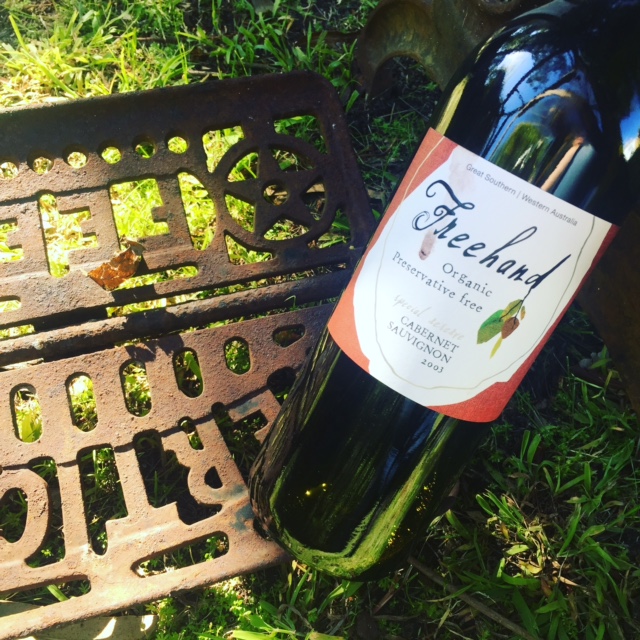
Aged Preservative Free Wine! Freehand Natural Wines 2003 Cabernet.


AGED PRESERVATIVE FREE WINE!

Since the dawn of winemaking time there have been arguments about just how long a bottle of wine will last if we don't use preservatives of some kind (usually sulphur dioxide 220 or potassium metabisulphite 224. If you want to know more about preservatives in wine read this article).  Many of the preservative free wine producers opt for the conservative approach making the wines in a "drink now" style, they advise a maximum cellaring of 1-2 years, and only produce smaller quantities that will sell out before the next vintage.

Matt Eastwell and his pals at Freehand Natural Wines have decided to push the envelope on this one, and all I can say is THANK GOODNESS THEY DID!  We now have in our stock an incredible Aged Preservative Free Cabernet, 2003 Vintage.  Before I rave on about the wine, let me rave on about Freehand… A relatively new winery in the Great Southern Wine Region of WA, Freehand is what it says it is.  A non-certified, organic and biodynamic vineyard.  Wines are produced by Matt and his highly committed team.  They are passionate about the environment and making sure that this vineyard and the earth in general are in better nick when it comes time for them to leave it.  These lovely people are to be admired for their philosophies and the way they grow grapes and produce wine.  Don't let the lack of certification put you off!

Now to the wine, sigh… The 2003 Cabernet is a deliciously mellow drop.  Made gently by hand with small, intensely flavoured berries it has a gorgeous cherry red colour, with orange highlights around the rim.  First sniff leaves you with lovely aged characters of leather beeswax and tobacco leaf, and just a little earthiness.  Basically it makes you want to just dive right on it.  But don’t rush it, this wine has been waiting 12 years to be tasted, so please spend some time savouring each of the elements.  The mouth feel is oh so velvety and silky smooth.  It’s a bit dangerous really, as it’s very easy to find yourself at the bottom of the bottle without too much effort.  The flavour profile is cedary with a savoury edge, and just a hint of blackberry fruit, although as the wine breathes it seems to change and evolve with each mouthful. I'm sure, if we'd managed to leave some in the bottle for the night, it would have had a totally new flavour profile in the morning.  This wine has aged exceptionally well, and could easily get away with claiming to be a few years younger.  

It is delicious and a bargain for $30 or under. Buy it here!

Happy drinking!

Sunday, 11 October 2015

How to store wine.

So, have you got yourself a wee collection of wines that you've been purchasing over the years?  Some might have been gifts, others lovingly collected from a weekend of exploring cellar doors with mates.  Some might be organic, others not.  I don't know about you, but I've begun to grow up when it comes to wine.  No longer do I need to drink ALL THE WINE in one sitting with pals.  I am happy to buy a bottle and have it tucked away until the right time.  Sadly, for many this can all end in tears when a bottle isn't stored correctly.  


Before I got into this wine caper I confess that my bottles of wine were stored in the bottom of my kitchen cupboard.  There was easy access, and it was as good a place as any considering I didn't have a wine rack, or a cellar, or a convenient backyard cave, with steady temperatures to squirrel my bounty away in.  Now I'm a bit more savvy and try a bit harder to make sure my bottles of precious vino are as well stored as possible given my limited space, and lack of a fore mentioned cave.  I confess to being a bit lucky in that my parents have a cellar at their home in the mountains.  If I have a particularly special bottle I can always VERY CLEARLY LABEL IT WITH MY NAME, and pop it in among their collection.  So far there have been no accidental consumption incidents.

I hear you...no cellar, no cave.  What to do?  Well, I've got a few tips for keeping your wine at its best for as long as possible.  I do have to say, please read your labels though. Ifa wine maker suggests that a particular wine would benefit from 5 years of cellaring, don't wait for 15 and then wonder why it's not great...  common sense peeps.
How's this for a nifty little cellar.  I'm sure I could fit this under my stairs...?

I've got a few tips on storing your wine and keeping it in the most optimal conditions.  I've read quite a bit on the subject, and the phrase that springs to mind and is easily remembered is 'Keep it cool, keep it dark, keep it still, keep it sideways'.  Pretty simple really.

Wine is a pretty delicate thing which is always evolving and changing within the bottle, and outside influences can interfere with the delicate dance happening beneath the cork.


Wine and bright lights are not best friends.  Most coloured wine bottles offer a small amount of protection against UV  light.  However, it isn't enough to keep your wine from being effected by light, which will prematurely age your wine.  White wine is particularly vulnerable to this, but red wine is also at risk.


It's best to store your wine in a cool, dry dark place with a constant temperature (between 12-16 °C).  If you don't have a cellar (which of course is the best place to keep your wine), keep it in the box it came in in a dark place (there must be a spot in the bottom of a cupboard somewhere?).  Ideally there should be some humidity to prevent the cork from drying out.  If you're feeling really flush you could buy one of those fancy (or less fancy) thermo-controlled wine fridges (of course this is another electrical appliance which needs to be plugged in and takes up space...but if you're a real buff might be worth it).

Shake, rattle and roll.  I don't think so.  Wine doesn't like to be shifted about or exposed to vibrations and movement.  Try keeping it away from your fridge, on its side on a rack (this ensures the cork is always covered with liquid and won't dry out).  If you keep your bottles upright you increase the chances of oxygen making its way into your bottle and oxidizing the wine.  Of course, corks can be a bit of a rarity these days, so the chances of oxidization are greatly reduced, and cork taint is almost unheard of!


Very importantly it must be remembered that not all wine is designed to be cellared.  And even those that are may only be suitable for a short cellaring period.  Many preservative free wines are made to be drunk quite soon after bottling.  Please, please, follow the instructions of the wine maker.  They want you to enjoy their wine, and will be giving you the best advice on when to drink their nectar.  


Many people that that white wine is not meant to be cellared.  This simply isn't true.  Many whites are intended to age gracefully, their flavour profiles changing and maturing along the way with secondary characters and complexity only developing with time. Think Riesling, Semillon and Chardonnay.  Red wines will always prefer some time in a bottle to allow all the goodness to harmonise.  Be it Shiraz, Cab Sav or Pinot, let the fruits, tannins and acids find their place before opening!  Be patient.  And then....
Happy drinking!


Monday, 5 October 2015

Being a FRUGAVORE

I'm a bit of a 'frugavore' these days.  If you've not heard of the term is was the recent title of a book by Arabella Forge and essentially outlined how we could live more sustainably, more locally and hence more cheaply by cutting back on excesses, growing our own food, etc, etc.  It's not rocket science, but it does take a bit of an effort.  It helps that I work from home (while raising three small children), and that I pull in enough money from all my little bits and bobs to get in home child care when I need a few hours to smash out a blog post, or write some assessment documents (that's right, my life is not all about wine!), or cook up a pot of stock, or a huge meat sauce.  It also means I have the ability to search out the cheapest local produce to cook with!

 Wherever possible I try to buy organic produce, however in my old age I am beginning to see just how important food miles are, and free range of course.  My priorities have shifted a bit and I'd buy a locally grown, seasonal, free range product over organic if push comes to shove.  I will also choose free range eggs over organic.  Gotta love a happy hen!

The best way to be a frugavore is to grow your own vegetables, and if possible to keep a couple of happy hens who will keep you in eggs.  Obviously it is cheaper if you are a vegetarian, which I am not, but we do try and eat mostly vegetarian meals, with meat appearing on the menu only a few times a week, and then in small quantities (a 100 gram steak is all I'd ever dish up to my family members).  It's also really helpful to think about meals further ahead than 'tonight'.  For example, tonight I am poaching a whole chicken with a bunch of vegetables.  The kids will eat the chicken and veggies for dinner.  We grown ups will have the chicken with a salad from the garden, and tomorrow I will make a soup from the broth.  The rest of the chicken will go for a few more days, with bits for the soup, for wraps for kids lunches, and possibly in a pasta dish.  There won't be any waste (except for the bones) and I know that we will be eating nutritionally, and cheaply, for at least 4 evening meals this week from that one starting point.  Any broth left over I'll freeze for another day, always good for risotto or the like.  A bit of planning will really save you in the long run.

I've got a few tips below on how to keep your grocery costs as low as possible (I spend about $50 a week on fresh vegetable/fruit produce for a family of five, plus about another $100 on dry good, bread, milk, meat and incidentals like toiletries, cleaning products and such).  I'd love to hear your tips, so feel free to leave me a comment!


1.  SHOP SEASONALLY!  When I was a bit younger and had more time to fiddle around in the kitchen making amazing meals to impress my friends I would buy whatever I needed at whatever cost...WTF was I thinking?!  Now I buy only what is in season and Australian (preferably from my own state).  No more Peruvian asparagus, or Chillean blueberries.  If it's not in season, it's not hitting my table.  Yes, this can be a bit dull.  My kids are thoroughly sick of apples and pears by mid-winter.  When those first punnets of strawberries and blue berries become available it's like Christmas (literally!).  Fortunately, we can all adapt, and sometimes we could all use a lesson in what it means to fly exotic fruits across the planet.  Global warming is that lesson.  I'd rather have a planet that we can live on than a mango out of season.


2.  Find your local fruit market and use it!  I walk up to the Brunswick Market every week and do my shop.  The produce lasts the whole week, is local and fresh.  It's also lovely to see the cultural groups who live in your area doing their shopping.  The Brunswick Market is super 'Turkish', so lots of Evil Eyes, Halal meat and okra are on offer.   I can always get a piece of cheese, or locally packed spices, which is great and it keeps my menu ideas interesting. 


3.  Cut back on the meat.  Yep, no-one NEEDS a 500 gram t-bone steak to meet their iron needs.  Meat is expensive and just not necessary in such quantities (or at all if you are willing to balance your diet in other ways).  Try reducing your portions, or making several of your meals 'meat free'.  Your body will thank you for it, and so will your wallet.

4.  Don't go shopping when you're hungry.  Seriously.  How did that packet of chips end up in your trolley?

5.  Have a vegetable plot and grow seasonal veggies in it.  Leafy greens like chard or kale are always a winner (and dead easy to keep alive), beans, peas, tomatoes, Asian greens, herbs, the sky is the limit depending on space.  Nothing is more impressive than cooking up a meal with ingredients entirely grown in your own garden.


6.  Get into food trading!  My neighbours and I have a 'food swap' situation going on.  Each of us cooks up something on a three weekly rotation and delivers it to the others in the swap.  It's awesome!  One night a week we have a meal delivered that we didn't have to cook.  Many a time it's been a lifesaver, for all concerned.

7.  Buy and cook in bulk.  Large sacks of rice.  Big batches of Bolognaise sauce, or Passata.  These things will freeze, or last for ages, and mean you have meals at the ready...less takeaway baby!

If you've got the time have a look at Arabella Forge's Foodwise site.  It's pretty clearly laid out and shows how a bit of thought and effort can help you live more cheaply and healthily!

Of course - WINE. as an aside if thinking about your carbon footprint is important to you when it comes to selecting what wine you drink please have a look at our website.  Wineries that produce organic wine tend to care about the way they produce their grapes.  Sustainable practices are often at the forefront of their production.  They aim to lessen their impact on the earth, and leave it in better nick than when they found it.  You can see that buying organic wine isn't only better for you, but better for the planet.   Most of the wines we sell are Australian (no, not all of them, but most), and many have super light glass bottles (again, not all...Kalleske you know I'm talking about you...).  Making a wine bottle as light as possible means that it has less of a carbon footprint when it's being shipped, locally or from overseas.  Many of our Temple Bruer bottles are uber light, and our Spanish wines by Vicente Gandia are prime examples of a 'lean green' light wine bottle, perfect for the export market.  'Phew,' I hear you say...thank goodness there is no need to stop drinking wine in order to be a frugavore!

Happy drinking!